No More Lunch Bag Let Down!

It’s hard to believe that it’s only been a few weeks since ‘back-to-school’ kicked in.

Among the many challenges of getting back in to the routines that come with this time of year, is wracking your brain with what to pack your kids (or yourself!) for lunch, day-in, day out.

We all do our best to include healthy food in our children’s lunch boxes (and our own for that matter!); however, sometimes the difference between a child eating or not eating their lunch is all in the “marketing”, that is, the presentation and packaging.

Fun & kid-friendly containers can help transform lunch-bag letdown into lunch-bag fun! My kids are all grown up now, but our favourite lunch gear was from a company called Bentology. Bentology products are designed to help you pack nutritious bento box style lunches for school (or work … or play!). The unique design of this durable line of products makes it easy to break free of the sandwich mentality, and as a bonus, the products are free of phthalates, BPA, PVC, or lead.

Click here to check out these great products … and if you’re looking for healthy lunch and snack ideas, check out my September Tip of the Month, “10 Ways to Think Outside the Lunch Box”.

Happy lunching!

Anna

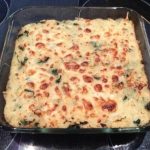
Cheesy Cauliflower & Spinach Casserole

This casserole is inspired by a signature dish that is served at the Green Door Restaurant – Ottawa’s oldest vegetarian restaurant. The Green Door’s dish is called ‘Mashed Potato Kale’. I use cauliflower instead of starchy potatoes, and spinach instead of kale (you can use any cooked greens that you like actually). I also add in some coconut oil. I love my spin on this potato side dish! I hope you’ll try it and enjoy it as much as I do. Maybe it will even make it to your Thanksgiving table! Can be prepared a day or two in advance if you wish! Enjoy!

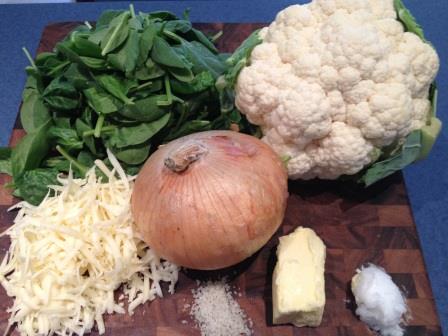
What You’ll Need

IMG_3661 WEB

  • I head of cauliflower
  • 1 large onion
  • 1 large bag of baby spinach (or greens of your choice)
  • 1 cup shredded medium cheddar (I used organic made from raw milk)
  •  4 TBSP of butter
  • 2 TBSP of coconut oil
  • Unrefined sea salt (1/2 – 1 tsp … to your taste)

Step 1 – Steaming & Sauteeing

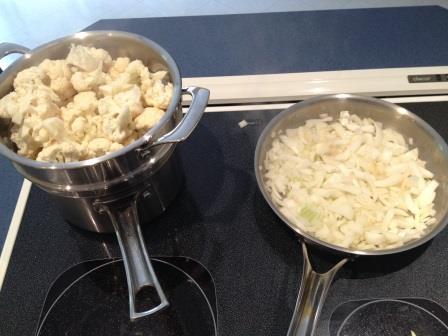
IMG_3662 WEB

  • Cut up the cauliflower and steam it until it is soft enough to mash (15 minutes or so)
  • Finely chop the onion and put it in a pan with 1 TBSP each of the butter and coconut oil. Cook over medium-low heat until the onions are soft and translucent and just starting to brown.

IMG_3665 WEB

  • Chop up the spinach and toss it in with the onions for the last few minutes of cooking

Step 2 – Mashing & Mixing

for web

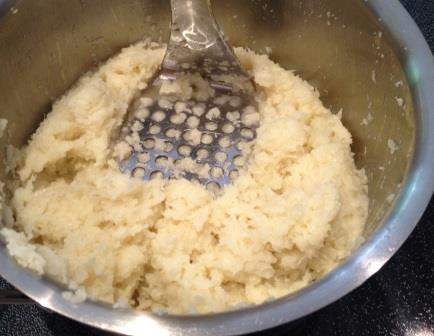
  • Mash the cauliflower with the salt and the remaining butter and coconut oil until it is nice and smooth. This dish is yummy to eat right now as an alternative to mashed potatoes. If you have a favourite mashed potato dish, try substituting the potato part with cauliflower!
  • Once you’ve mashed the cauliflower, mix in the cheese and the onions and spinach

Step 3 – Baking

IMG_3669 WEB

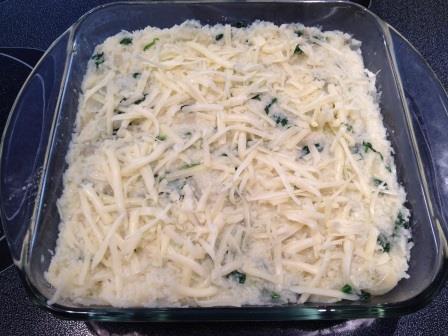
  • Spread the cauliflower mixture in to a 9 X 9 baking dish, smooth it out, then sprinkle the grated cheese on top
  • Put in a 350 F oven for just long enough to warm it up (10 minutes or so), and if you want golden, bubbly cheese, finish it off with few minutes under the broiler

You can prep this casserole in advance – right up to it being oven ready (e.g. sprinkled with cheese), and keep it refrigerated for a day or two. It even freezes beautifully, so you can freeze it before or after it goes in the oven. You’ll just have to lengthen the warming time if you’re putting it in the oven from the fridge or freezer.

Bon appetit!

Getting the Most From Avocados

Avocados are loaded with health-boosting nutrients, including powerful antioxidants and hearth-healthy monounsaturated fats.

The method used to prepare or ‘peel’ an avocado can make a difference in the level of nutrients that you end up getting from it.

In this video, I’ll show you how to select, peel, and store an avocado to maximize it’s health-boosting goodness.

Enjoy!

3 Reasons Why I Avoid Potatoes

You say potatoes, I say no thank you.

For years, I’ve avoided potatoes. It initially started as an attempt to improve my digestion by avoiding the protein-heavy-starch-heavy ‘meat and potatoes’ typical meal combo – one of the most challenging food combos for the tummy from a holistic nutritionist’s perspective. Food combining aside, I avoid potatoes for a number of other reasons.

#1 – Starch

sugar cubesPotatoes contain a lot of starch, and starch is nothing but a whole bunch of glucose (sugar) molecules all lumped together. Most plants produce starch as a way to store energy, and it’s contained in large amounts in potatoes. When we eat foods that are high in starch, our digestion breaks the starch down into glucose. Glucose is very quickly absorbed from our digestive tract into our blood stream, so it can very quickly spike our blood sugar, causing a reflexive spike in insulin, our fat-storing hormone.

How quickly a food spikes our blood glucose is measured by something called the ‘Glycemic Index’. Glucose, the benchmark for the glycemic index scale, has a glycemic index of 100. Here are the glycemic index values of various potatoes:

  • Unpeeled, boiled red potatoes – 89
  • Peeled, baked white potatoes – 98
  • Baked Russet potatoes – 111 (that’s higher than glucose!)

When you look at glycemic index values, potatoes are pretty high up there. Remember that foods with a high glycemic index can cause blood glucose levels to rise very quickly, which means blood insulin levels will also rise very quickly. When this happens over and over again, we can set ourselves up for blood sugar problems, which affect multiple areas of our health and vitality.

If you are going to eat potatoes, here are a couple of tips to lessen their rapid blood sugar raising potential. First, go for what I refer to as a ‘high-peel-to-starch’ ratio. Potato peels are full of fibre and other nutrients that will help to prevent a quick spike in blood glucose. Small red potatoes and/or fingerling potatoes fit this bill. Compared to a big ole baking potato, you’ll get a higher peel-to-starch ratio with smaller potatoes. If you’re going to eat the peel, look for organic potatoes (see #3). Second, lay on the fat! Generously mash in or melt on the butter or olive oil. Fat, like fibre, will help to slow down the rate at which glucose enters the blood from the intestinal tract.

#2 – Solanine

potatoes sproutedPotatoes are part of the ‘nightshade’ family. Nightshade plants (which also include tomatoes, paprika, eggplant, tobacco, and peppers) are often cited as containing chemical substances called alkaloids, specifically one called solanine. Solanine levels are higher in potatoes that are green and/or are sprouting, so at the very least, avoid these potatoes. Interestingly, green and sprouting potatoes are both related to light exposure, so if you’re going to have potatoes in the house, store them in a dark, cry, and cool (7-10C) place. Over the years, I have read many articles that suggest that solanine promotes inflammation in the body and can contribute to joint pain, joint swelling, and all forms of arthritis, especially among individuals who are especially sensitive to it. Solanine can also cause digestive discomfort.
Not everyone who has joint pain and/or swelling is sensitive to nightshades – and many nightshades are also loaded with health-boosting nutrients – however; if you have joint pain and/or swelling, you may want to consider avoiding nightshades for several weeks and see if you notice a difference.

#3 – Pesticides

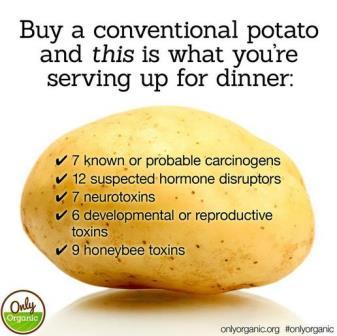
potato pesticidesConventional potatoes (e.g. non-organic ones) are loaded with pesticides. According to the Environmental Working Group, the conventional potato tested positive for 35 different pesticides, including: 12 suspected hormone disruptors, 9 honeybee toxins, 7 neurotoxins (negatively affect the nervous system, including the brain), 6 known or probable carcinogens, and 6 developmental or reproductive toxins (sung to the tune of ‘The Twelve Days of Christmas…). Interesting and sad fact – this is more pesticides by weight than any other vegetable, and unfortunately, some of these pesticides are still present after potatoes are peeled and washed. So, if you absolutely must have potatoes, look for organic ones. I’ve read that less than 1% of potato production is organic.

For those of you who are saying “YIKES! What am I going to eat if I can’t eat potatoes?” How about cauliflower, which is abundant locally and organically and economically at this time of year at your local farmers markets. I have a great recipe for Roasted Cauliflower in the Recipe Section of my website. Check it out and stay tuned for a great cauliflower side dish recipe that I hope to have ready for you just in time for Thanksgiving!

Take control of what you can!

References
http://www.onlyorganic.org/the-potato-one-of-ewgs-dirty-dozen/

Support Joint, Cardiovascular & Cognitive Health with Neptune Krill Oil

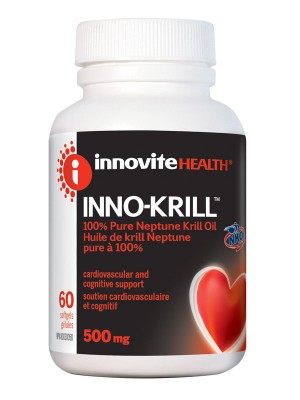
100% Neptune Krill Oil (NKO) is a great source of inflammation-busting omega-3 essential fatty acids. It carries omega-3s in a type of fat called phospholipids, which greatly enhances NKO’s absorption into cells, allowing cells to reap all of the health benefits associated with omega-3s.

study published in The Journal of the American College of Nutrition clearly indicated that NKO at a daily dose of 300 mg significantly inhibited inflammation and reduced arthritic symptoms within a short treatment period of 7 and 14 days.

NKO also contains astaxanthin – a powerful antioxidant that protects our cells from the damage that can be caused by free radicals. A great brand of NKO is OCEANO3. While there are a lot of krill oil products appearing on the market, not all of them are created equal. OCEANO3 Neptune Krill Oil:

  • has more antioxidants than other brands
  • is 100% pure with no toxins or contaminants
  • has no reflux or fishy aftertaste
  • comes in small, easy-to-swallow softgels
  • has been certified by Friend of The Sea for sustainable krill harvesting

Now you can order OCEANO3 through Perfect Resonance Natural Health Counselling for just $40 + HST = $45.20 (note this pricing is quoted as of March 2017 and is subject to change). At a general dose of just one 500 mg soft gel daily, this product provides a 2-month supply of anti-inflammatory power.

To order, please email info@perfectresonance.com and put ‘OCEANO3 in the subject line. You will receive a confirmation email with payment instructions when your order is ready for pick up through Perfect Resonance Natural Health Counselling, located in the Marshall Health Clinic at 2605 Carling Avenue, Ottawa ON.

As always, whenever you start taking a new supplement, it’s important to let your doctor and/or other health care practitioners know, especially if you are on any medications.

Take control of what you can!


Grilled or Roasted Veggies on Quinoa Tabouleh

This is a great side-dish at any time of year, but especially when farmers markets are bursting with fresh, local veggies. You can serve it warm or cold, and leftovers keep well for a few days. I recently made this dish for a family reunion of 24+. Easy to make for a big gathering! This recipe serves 6 to 8 people, depending on what else is on the table! I’ve also often served just the grilled veggies or just the quinoa tabouleh as a side dish, so this is really two recipes in one, and the instructions will be presented as such. You can get the veggies and quinoa going at the same time (if you’re a good multi-tasker!), otherwise, get the veggies done first, then make the tabouleh. If you want to serve this as a warm dish, you can keep the veggies warm in the oven or on the grill while you prepare the quinoa part. This dish is LOADED with nutrients and fibre – and it’s DELICIOUS. I hope you’ll give it a whirl!

ACT 1:

Grilled or Roasted Veggies – What You’ll Need


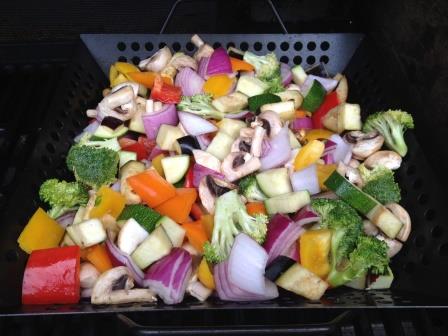
IMG_6194Start by chopping up a variety of veggies in to bite-sized pieces, enough to give you 6 to 8 cups. This time around I used:

  • broccoli
  • red & yellow bell peppers
  • red onion
  • zucchini
  • eggplant
  • mushrooms (I usually use shiitake, but the grocery store was out this time around)
  • you could also use cauliflower, asparagus, whole cherry tomatoes, turnips, squash, beets, parsnips, green beans…any veggie that would grill or roast well
  • you’ll also need some olive oil and Herbamare (or salt, pepper..whatever spices or herbs you’d like to add)

Put the chopped up veggies in to a large bowl and drizzle with enough olive oil to coat them well (around 1/8 to 1/4 of a cup). Add salt and pepper to taste if you wish. I used Herbamare

Grilled or Roasted Veggies – Cooking

IMG_6195

  • Once you have all of your veggies chopped up and tossed in oil, you can roast or grill them. I grilled them over medium heat in a grilling basket. Stir the veggies every few minutes or so to ensure they cook evenly. You don’t want to overload the basket, so depending on the size of your basket, you may need to do them in batches. Grill until the veggies start to get a bit golden, but are still crisp. Depending on your grill, this might be 10 to 15 minutes.
  • If you want to roast the veggies, preheat your oven to 200C, then spread the veggies in a single layer on a roasting pan (I would line it with parchment paper), and roast for 30 minutes or so, until veggies are tender. You’ll want to gently turn them a few times while they are roasting.

When the veggies are done, they’ll look something like this (it’ll look like less than what you started with!):

IMG_6196

Serve as is, or if you want to serve them on quinoa tabouleh, keep on reading!

ACT 2:

Quinoa Tabouleh – What You’ll Need

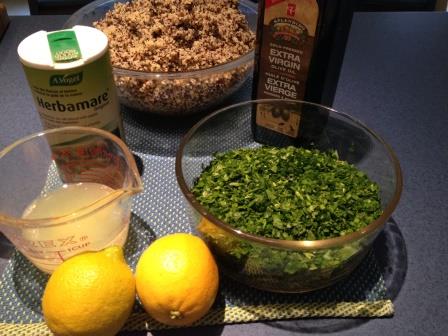
IMG_6203

In the above photo, the quinoa is already cooked – and I took the photo the last time I made this dish … which was to serve 24+ … but the instructions below are for serving 6 to 8!

  • 1.5 cups of uncooked quinoa
  • 3 cups of water OR chicken broth (or broth of your choice)
  • 1 bunch of Italian parsley, finely chopped (I cut off most of the stems)
  • 1/4 cup of fresh squeezed lemon juice
  • 1/4 cup olive oil
  • Herbamare (or salt, or whatever spices you’d like to add)

Quinoa Tabouleh – Cooking/Prepping

quinoa cooking

  • rinse the quinoa in a fine strainer/large seive to remove the saponin (the seeds natural coating that make quinoa taste a bit bitter), letting the water drain when done
  • add the drained quinoa to a saucepan with 3 cups of water or broth
  • bring to a boil, uncovered, then reduce heat to low and bring to a gentle simmer for 15 minutes
  • remove the pot from the heat, and let stand, covered, for 5 minutes. Then remove the lid and fluff up the quinoa with a fork. If there is any liquid still in the bottom of the pot, you can return the pot to low heat and cook for a few more minutes until the water is gone
  • transfer the cooked quinoa into a large mixing bowl then add the lemon juice, olive oil, parsley (reserve a few TBSP for a garnish), spices, and mix well. Give it a taste and adjust to your liking

Serve as is, or if you want to top with grilled/roasted veggies, keep on reading!

GRAND FINALE:

Assembling & Serving

IMG_6205

  • spread the quinoa tabouleh out on a large serving platter, creating a ‘nest’ for the veggies
  • spoon the grilled veggies on to the ‘nest’
  • sprinkle with reserved chopped parsley

If you’d rather serve this as a salad, then just mix the veggies and tabouleh all together, then garnish with parsley.

Enjoy!


Are These Cute Little Bears BS-ing Us?

Look at those cute little bear faces. It’s hard to believe they may be hiding a big fat lie that could be harming your health. If you or someone you know buys or eats Kraft Peanut Butter (or Jiff, or Skippy, or any of those types of peanut butters), you’ll want to read and share this post.

For the past week or so, I’ve been trying to get Kraft Foods to answer a simple question that I emailed them through their website, and that is: “Can you please confirm if the hydrogenated oils used in your peanut butters that state a ‘Zero Trans Fat’ claim are fully hydrogenated, partially hydrogenated, or a combination of both?” I’ll share the answers I received in just a minute…

Daytime trans fat scareyIf you watched my Video of the Month last week, you may recall that it was about ‘big fat lies’ in the food industry. One of the topics I talked about was health-damaging trans fats. I explained how manufacturers can make a trans-fat-free claim on a packaged food even if it contains trans fats. This is possible thanks to current labelling laws in Canada that allow manufacturers to make a trans-fat-free claim if there is less than 0.2 grams of trans fat per serving; make the serving size small enough, and they’ve got themselves a trans-fat-free claim. Finally, I suggested that regardless of whether or not there is a trans-fat free claim on a packaged good, you have to read the label – and that in terms of fats and oils, it would be in the best interest of your health to avoid packaged foods that contain:

  • Shortening – industry sources say shortening may or may not contain trans fats depending on how it’s processed. I stay away from it.
  • Partially hydrogenated oils – industry sources admit these are trans fats
  • Fully hydrogenated oils – industry sources claim these do not contain trans fats; but they are still chemically altered
  • Modified oils – doesn’t necessarily mean hydrogenated – it depends on how the oil has been modified (so who knows for sure!)
  • Interesterified oils – made by a chemical process that creates a product that’s somewhere in between a fat and an oil (and some research suggests it’s just as bad as trans fats)

If a peanut butter isn’t ‘All Natural’ (e.g. just peanuts and maybe some salt and/or sugar), it’s likely going to contain some type of hydrogenated oil as an ingredient (e.g. rapeseed and/or cottonseed, and/or soybean) in order to give it a creamy and smooth texture, as well as an unaturally long shelf-life. Some of these products have a ‘Sensible Solution’ banner on them that highlights a few positive health claims, including the fact that the product is trans-fat-free…just like this:

kraft peanut butter label

Since more and more consumers are shying away from products that contain ‘hydrogenated oils’, some food manufacturers now use ‘interesterified’ oils (six of one, half-dozen of the other?). Others make the following distinction: partially hydrogenated oils contain trans fats, but fully hydrogenated oils do not.

This last statement sounds straight forward, but what if an ingredient label just lists ‘hydrogenated XYZ oil’ like the one above does? How do you know if it is fully hydrogenated (not supposed to contain trans fats), partially hydrogenated (contains trans fats), or a mix of both (contains trans fats)? I also have another question – when an oil is processed to become a fully hydrogenated oil, how do manufacturers know that all of the oil gets fully hydrogenated? Is it possible that some of it only gets partially hydrogenated?

Who better to answer these questions than a company that makes a product that is a staple in so many homes – one that makes a trans-fat-free claim on its packaging, and that list ‘hydrogenated oils’ as an ingredient. Who is that company, and what is the product? Kraft Foods and Kraft Peanut Butter.

So, a few weeks ago, I sent Kraft Foods an email and asked them if they could answer those questions for me.

Here’ the first answer I received:

Hi Anna,

Thank you for visiting http://www.kraftcanada.com.

This process of adding hydrogen converts unsaturated vegetable oil, which is liquid at room temperature, to a more solid more saturated vegetable oil.

Hydrogenated oils are used because they are more stable which helps to ensure the quality of a product throughout its shelf life.

Hydrogenated oils are generally used in small amounts in products.

If an oil has been hydrogenated, it would be listed as such on the ingredient statement.

As with all fat-containing ingredients in our products, the fat content of this ingredient is factored into the “total fat” – declaration on the Nutrition Facts panel.

Products containing hydrogenated oils can be part of a nutritious diet if the fat content of one’s total diet is within the current guidelines.

If you haven’t done so already, please add our site to your favorites and visit us again soon!

Sincerely,

XXXX

Associate Director, Consumer Relations
Kraft/Heinz Case: 80189967

I was impressed with how quickly I received this response, but unimpressed that it didn’t answer a single one of the questions I asked…so, I replied, thanked them very much for the email, but let them know that it didn’t answer any of my questions regarding the ‘hydrogenated oils’ used in the peanut butter, so this time I numbered my questions and asked if they could specifically and directly respond to each one as follows:

  1. Is it fully hydrogenated, and if so, how do you know that the oil is indeed fully hydrogenated?
  2. Is it partially hydrogenated?
  3. Is it a mixture of fully and partially hydrogenated?
  4. If it is not fully hydrogenated, that means there are trans fats in the product. Can you please confirm the amount of trans fats per serving?

I then received this response:

Hi Anna,

Thank you for visiting http://www.kraftcanada.com.

I’m sorry as I’d like to assist you, the information you’re requesting isn’t currently available. I apologize for any disappointment this may cause you.

It was great hearing from you, and remember we’re always updating our site so visit us again soon!
Sincerely,

XXXXX

Consumer Representative
Kraft/Heinz Case: 80189967per

What the heck? The information I requested “isn’t currently available”? Really? Is their server down? The one that contains all the nutritional information about their products? How is it possible that one of the top food manufacturers in the world doesn’t know if the hydrogenated oil in one of their most popular products is fully or partially hydrogenated, which means they can’t (or perhaps don’t want to?) confirm if the product contains any trans fats? Really? How curious.

So, what do you think? Are these cute little bears BS-ing us?

I’m going to end this blog with a challenge that may help us get some straight answers.

Go to this link, http://kraftcanada-en.custhelp.com/app/contact and send Kraft Foods an email asking them the exact same four questions I did and let me know if you get a straight answer. Challenge your friends and family to do the same. Hopefully someone will eventually get a straight answer, and if so, please forward it to info@perfectresonance.com and I will spread the word.

Take control of what you can.

Privacy Policy

Website Maintenance and Services by Andrew Wardell