Are You Wearing a Face Mask?

I’m curious. Who is considering wearing, already wearing, and/or sewing face masks?

The recommendation regarding face masks during this pandemic seems to be changing by the hour. While staying home is still the best way to protect yourself from the coronavirus, the CDC (Centers for Disease Control) now says that masks are effective as an additional measure when you go out.

An interesting article I just read on the topic included a table showing what materials are most effective for making masks (vacuum cleaner bags rated the best) and a great video tutorial for making a mask. Here’s the video:

It’s important to be aware of when and how to wear a mask, as well as the issues related with wearing masks, which to my understanding include:

  • not wearing them properly
  • re-using single-use masks
  • not disposing single-use masks properly
  • not washing home made cloth masks between uses
  • not washing home made cloth masks properly between uses
  • to understand that when masks get moist with condensation, their effectiveness decreases

The CDC has posted more information on how to wear, remove, and wash/sanitize cloth face masks, as well as tutorials on how to make them with various fabrics. Click here to learn more. 

After humming and hawing about mask, yesterday I decided I would make a bunch for myself and my family. I am making 2 masks each, so we have one ready to go while the other one is being washed. I followed the pattern in the video I shared above. I chose this pattern because this mask fits well and it is reusable – and I have a sewing machine. (If you don’t have a sewing machine, check out this non-sewing pattern of how to make masks using T-shirts). Here are the materials I used, as this is what I had on hand (very festive!):

Here is what the finished product looks like:

Since this pattern has a ‘filter pocket’ on the inside of the mask, I’ll be inserting a fresh filter each time I put on a clean mask. I have some old vacuum cleaner bags, so will be cutting those up to into rectangular shapes to fit. I’ve also heard you can use Swiffer-like cloth as filters, but the mask will still be useful without a filter.

Finally, I would like to thank all of you who are working through this pandemic to keep us healthy, safe, fed, occupied, and connected … and to everyone, stay safe, stay healthy (please eat healthy – check out my RECIPES tab!) both mentally and physically, stay positive, and stay home if you can.

Why You Might Want to Try (Making Your Own) Kombucha

I have been drinking kombucha for years. It’s just one of the many things I do to support a healthy gut … which is key in supporting overall health. I typically have two 4-ounce drinks of kombucha per day – one in the morning, and one late afternoon/early evening. As with most things, more is not always better, with 16 ounces of kombucha (four 4-ounce servings, spread out over the course of the day) often being sited as the  maximum daily amount that should be consumed per day. If you’ve never had kombucha before, start with one 4-ounce drink per day for a week or so, then increase slowly.

I always knew that some folks made their own, but I didn’t think I’d have the time or skill to do it  … that is, until a friend came over with a SCOBY (symbiotic colony of bacteria and yeast – the necessary starter to brew a batch of ‘booch) a few months ago and made a batch with me. It was pretty darn simple, waaaaaay more economical than buying it, the results were great, and it was fun creating my own flavours!

I’ve made 3 batches now, and they’ve all been slightly different. Results can vary depending on temperature, brewing time, the quality of the SCOBY, and a few other factors; however, every batch has worked out and I’m not afraid to experiment to figure out what leads to a successful brew (if it doesn’t work, its just some tea and sugar that have gone to waste). If you take a crack at making your own and it doesn’t turn out right the first time, I encourage you to keep trying! It helps to know what kombucha should be like, so if you’ve never tried any before, make sure you do before brewing your own!

In this post, I’ll take you through the equipment and ingredients needed to brew your own kombucha (fondly referred to as ‘booch’), as well as a step-by-step ‘recipe’ with lots of photos.  Hope you’ll try it! 

You Will Need:

  • a gallon-sized glass mason jar
  • three 1-litre glass bottles with screw on or flip-top caps
  • an instant-read thermometer
  • a 6 or 8 litre stainless steel pot
  • a slotted wooden spoon
  • a funnel
  • fine mesh strainer
  • a clean cotton cloth or large paper coffee filter or nut bag
  • 1 cup of pure cane sugar
  • 8 tea bags or 17 grams of loose tea (black tea, green tea, or oolong)
  • 2 cups of starter kombucha (for your very first brew, you will have to buy a bottle of unflavoured kombucha … after that, each time you make your own batch, you set aside 2 cups to use as starter for your next batch!)
  • a healthy SCOBY – get it from someone you know, or you can buy one at a health food store, or on-line.

Step 1: Wash All Equipment

It’s important to wash all the equipment that will come in contact with your kombucha in warm soapy water, making sure you rinse everything well to get rid of all soap, then let it all air dry. Use regular dish soap – NOT anti-bacterial soap.

Step 2: Make Sugary Tea

In a stainless steel pot, heat 4 cups of water to almost boiling. I sometimes heat the water in a kettle first, then pour it into the pot to speed this step up a bit. You will be adding tea (tea bags or loose tea) to this water, and the type of tea you use will dictate the temperature that the water should be before you add the tea, as follows:

  • Black tea: 200F to 212F

  • Oolong tea: 190F to 205F

  • Green tea: 170F to 180F

Each tea creates a different/unique kombucha base/unlfavoured kombucha. Black tea is strongest, green tea is mildest, oolong is somewhere in between and is often cited for having the most health-boosting nutrients.

Once the water is the right temperature, add the tea to the pot, stir, cover, then steep for 10 minutes or so. Halfway through, give it another stir and press the tea bags or the loose tea against the sides of the pot to extract more flavour/nutrients.

After 10 minutes of steeping, remove the tea bags/loose tea, then add the 1 cup of pure cane sugar and stir until the sugar is completely dissolved. I use loose tea and remove it by pouring the tea through a fine mesh strainer into another pot.

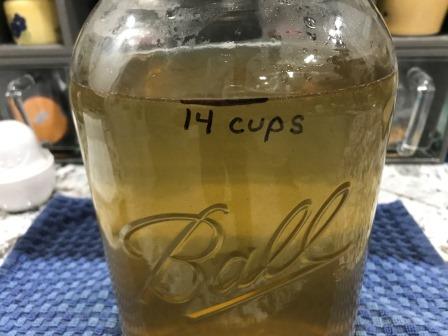
Once the sugar is completely dissolved, pour the 4 cups of sweetened tea into the 1-gallon mason jar, then add 10 cups of room temperature water. I marked my mason jar at the 14 cup mark with a permanent marker the first time I brewed so that I don’t have to measure 10 cups of water every time – I just fill the jar with water to the 14 cup mark AFTER I’ve added the 4 cups of sweetened tea.

Step 3: Add The Magic!

The next step involves adding the 2 cups of starter tea and the SCOBY … but first you must let the sugary tea in the mason jar cool down to below 85F. This is very important because if the temperature of the sugary tea is above 85F the bacteria/yeast balance of the SCOBY and starter tea will be disrupted, which will negatively affect the fermentation. Once you are at the right temperature, add the 2 cups of starter tea to the mason jar. If there is sediment at the bottom of the bottle of starter tea, gently turn the bottle upside down, then right side up again to ensure the sediment gets mixed into the starter tea as you want this sediment to get into the sugary tea in the mason jar.

Next, gently add the SCOBY into the mason jar mixture. Make sure your hands are clean before handling the SCOBY!

Cover the mason jar with a clean cotton cloth or large coffee filter and secure with an elastic. Your work is basically done now!

All that’s left to do is put the brew somewhere where it will be out of direct sunlight and at a temperature of between 72F – 82F … and wait (see next step). I usually wrap my jar in a dark dish towel and put it in the corner of my kitchen counter. I keep a glass of water beside it and use this water to monitor the temperature from time to time.

If the room temperature gets too cold (which can happen in the winter), I put the wrapped jar in my oven, turn the oven light on, and keep the oven door cracked open a bit using a wooden spoon. I have a small thermometer in the oven so I can monitor the temperature. You’ll want to monitor the temperature inside your oven BEFORE you put your kombucha in the oven to make sure the temperature is just right – you’ll likely have to play with how wide you leave the oven door open.

Step 4: The Waiting Game

Within a week, the SCOBY will have grown a second layer on its upper surface (looks like little white spots at first) and will have also spread across the top of the brew. I usually let my kombucha ferment for 7 to 9 days. The longer I leave it, the less sweet it is. You can do a taste test around day six. The best way to do this without disrupting the SCOBY/fermentation process is with the use of a plastic straw. Take the cloth/coffee filter off the jar of brew, take a clean plastic straw (you don’t want kombucha to come in contact with metal!), gently slide the bottom end of the straw down past the side of the SCOBY into the brew. Once you have the straw into the brew, seal the top end of the straw with your pointer finger – this will capture some of the brew in the straw. Keeping your finger on the top end of the straw, pull the straw out of the jar, put the bottom end in your mouth, and take your finger off the top end so that the extracted kombucha sample falls into your mouth. It shouldn’t taste really sweet – if it does, let it ferment for a few more days and repeat the straw taste-testing procedure until you have your desired taste.

Once your booch is how you’d like it, with clean hands, remove the SCOBY from the mason jar and place it in a glass container, covering it with a bit of the kombucha from the mason jar.

How to store your SCOBY will depend on when you plan on making your next batch of kombucha. Here are the instructions that a friend sent to me:

Now that you’ve taken care of your SCOBY, you need to pour off 2 cups of your kombucha into a glass jar or bottle and store this in the fridge. This will be your starter tea for next time around. I put the date the starter tea was poured off on the bottle with masking tape and a permanent marker.

It should be good for about 2 weeks. You can always buy a another bottle of plain kombucha for your next batch if necessary.

If you want unflavoured kombucha, pour the remaining brew in the mason jar into your bottles. To avoid messes as well as avoiding having strands of yeast end up in the finished bottled product, I put a funnel in the bottle, line the funnel with a fine cloth, and then pour the kombucha into the bottles, leaving about an inch from the neck of the bottle. Then seal the bottles, refrigerate, and enjoy. If you want flavoured kombucha, read Step 5.

Step 5: 2nd Ferment/Adding Flavours

If you want a flavoured kombucha, before pouring the unflavoured brew from the mason jar into individual bottles, add some flavours into the bottles. Use your imagination! If I am using fruit, I’ll add about 1/4 cup of the fruit to the bottle. If I am using ginger, I’ll use about 1 thumb-sized piece. If I am using herbs, I’ll add a generous sprig. Here are some of the flavours I’ve tried so far – and loved them all (although ginger is my staple!):

  • blueberry-lemon
  • raspberry-rosemary
  • ginger (my favourite)
  • pineapple-mango (pineapple makes things VERY FIZZY!)
  • cranberry-orange
  • cherry-hibiscus
  • apple-cinnamon (I used dried apples and a cinnamon stick)

For citrus flavouring, I use several pieces of zest. For fruit flavouring, I use fresh or frozen fruits, for hibiscus flavouring, I use hibiscus flower tea, for ginger flavouring, I use fresh ginger root.  Below are some photos to give you an idea of amounts and sizes of flavouring ingredients I have used.

Cranberry-orange
Ginger

Don’t be shy to experiment with what you add to flavour your kombucha. You’ll figure out what works and what you like best soon enough!

Once you’ve put the fruit/herbs/etc into the individual bottles, pour in the brew from the mason jar, leaving about an inch of space from the neck of the bottle. Put the bottles back in a dark place, between 72F – 82F … like you did with the first fermentation. I usually cover mine up with a dark towel again and leave them for 2 or 3 days …. except … this time … you have to give your booch babies a daily burp by very slowly opening the bottles to let out a bit of gas so they don’t explode on you. I have learned from others’ experiences and cover my bottles with a towel before I burp them … to avoid burp explosions that can lead to kombucha on your ceiling.  You’re welcome for the heads up! 

Once the 2 to 3 days of burping is over, you MUST refrigerate the bottles to stop the fermentation process. If it continues, the bottles could explode!

Next, enjoy … and maybe start your next batch right away!

Cheers to your health!

Cranberry-orange, cherry-hibiscus, and ginger booch all done!

The Perfect Gift Is Just One Click Away!

As of the writing of this post, there are only 39 shopping days until Christmas! 

If you like on-line shopping, check out the STORE section right here at Perfect Resonance Natural Health Counselling by clicking on the STORE tab in the green bar at the top of this page!

Here’s a sneak preview of what you’ll find there:

1. Products

In this section, you’ll find products that protect your health and give you some help with healthy meal prep. These include:

  • Products from Bentology to help make packing lunches and other meals convenient, efficient, and fun!
  • Products from Gia Wellness designed to neutralize the effects of your exposure to electromagnetic radiation from cell phones adn other devices
  • The InstaPot. Make anything from yogurt to main courses to desserts! The InstaPot slashes prepping, cooking, and cleaning time. I LOVE mine!
  • An apple parer/corer/slicer. I used mine non-stop this apple season!

2. Webinars

Learn everything you need to know about the important nutritional topic of fats. There’s a lot of contradictory information out there on this topic and being misinformed can be hazardous to your health, potentially increasing your risk of weight gain, heart disease, and numerous other health issues. What’s the big fat problem? Get this webinar and find out!

3. Gift Certificates

Gift certificates from Perfect Resonance make for unique and wonderful Christmas presents! Treat your friends, family, employees, co-workers, clients, or yourself to a relaxing and rejuvenating foot reflexology treatment … or one of may health-boosting services available through Perfect Resonance Natural Health. Check them out!

Books and DVDs

This section of the store lists dozens of my favourite health-related books (including cookbooks) and DVDs, including:

  • Real Food/Fake Food: Why You Don’t Know What You’re Eating and What You Can Do About It
  • The Oh She Glows Cookbook: Vegan Recipes to Glow From The Inside Out
  • The Heal Your Gut Cookbook
  • Coconut Lover’s Cookbook
  • Genetic Roulette (DVD): The Gamble of Our Lives

Get started with your holiday shopping right now by clicking on the STORE tab located in the green bar at the top of this page!

Enjoy!

Gluten-free Baked Pumpkin Spice Donuts

This delicious recipe is a great way to use up pumpkins or jack-o-lanterns you may have hanging around after Thanksgiving and Halloween festivities! You can also use store bought canned pumpkin puree. If you don’t have donut pans, the batter is also great for making muffins. The recipe makes about a dozen and a half donuts/muffins and they freeze really well.

You Will Need:

  • 2 cups of buckwheat flour
  • 2 cups of pumpkin puree. To make your own, clean out the seeds and any attached ‘stringy stuff’ from the inside of a large pumpkin (a 5 pound pumpkin should give you about 2 cups of puree). Cut the pumpkin into manageable pieces, and roast in a covered pan with just enough water to cover the bottom of the pan (about 1/4 inch of water). Roast at 375F for about 40 minutes or until the flesh is very soft. Cooking time will depend on your oven and your pumpkin, so check it from time-to-time to make sure you don’t burn it! Remove from oven, let cool, scoop flesh away from skin, and mash/puree the flesh.
  • 1 cup of xylitol or coconut sugar
  • 1/3 cup melted coconut oil
  • 1/4 cup melted butter
  • 3 large eggs
  • 2 tsp baking powder
  • 2 tsp ground cinnamon
  • 1 tsp each of ground cloves, nutmeg, and ginger
  • 1 tsp salt
  • 1 tsp vanilla extract

Step 1: Prep Wet & Dry Ingredients

  • Set oven to 350F
  • Combine all dry ingredients in a bowl and mix well
  • In a larger bowl, beat all other ingredients (‘wet ingredients’) together until they are creamy/smooth
  • Add the dry ingredients to the wet ingredients and beat or stir just until they are well combined

Step 2: Get the Batter in the Oven

  • I would recommend using non-stick donut or muffin pans. I did not coat mine with anything, but if yours tend to stick, you can lightly brush them with some melted butter or coconut oil. If you are using muffin pan, you could use muffin liners
  • If you are using a donut pan, fill each mold to the top with batter and then smooth the top of the batter with the back of a wet spoon or your finger (dip your finger in water first!). If you are making muffins, fill each muffin hole about 3/4
  • Bake about 15 minutes. Test to see if they are done by sticking a toothpick in the centre of one of them. It should come out clean when they are done. The tops may not look perfectly smooth … but they will become the bottoms once you flip them out of the pan!

Step 3: Serve

  • Once removed from the oven, invert the donuts onto a cooling rack. Hopefully they come out easily! If not, gently run a small knife or rubber spatula around the edges
  • You can let them cool (especially if you are going to freeze them), or serve warm. You can serve as is, or just before serving, brush the top of the donut with a bit of honey and then press it into some unsweetened shredded coconut (raw or toasted – your choice) or another topping of your choice!

Enjoy!

Make Dried Apple Rings With This Awesome Gadget!

I love fall and local apple picking season! I’m blessed with lots of organic, local apples from my parents’ apple trees and I don’t want a single one to go to waste!

One of the ways I preserve the nutrients and delicious flavour of local fresh picked apples is to make dried apple rings. This year, I bought myself a great gadget that makes coring, peeling, and slicing the apples into rings a breeze! It saved me hours of time and created a lot less waste (BTW, I used the peels and cores to make apple sage jelly. Mmmmm! Waste not, want not!)

Watch the video below to see how easy it is to make yummy dried apple rings. They make a great snack as is and can also be chopped up and added to baking, porridge, salads, soups … wherever you’d like the flavour of apples!

If you’d like to get yourself a handy dandy apple parer, corer, slicer like the one I’m using in the video, click here. Beware of cheap ones! You get what you pay for!

Enjoy!

The Lectin-Free Diet: Fact or Fiction?

It seems that every other day, some new theory surfaces in the nutrition world. Sometimes these theories are foundational to overall good health, but most of the time, they end up being just another fad. A recent theory that is getting a lot of attention is the numerous health benefits of a lectin-free diet. While I am no guru on this topic, I’ve read a lot about it. In this blog, based on my understanding and clinical experience, I’m going to cover the following:

  • what lectins are
  • the health pros and cons related to lectins
  • what foods are high in lectins
  • the health claims associated with a lectin-free diet
  • if a lectin-free diet could be the yellow brick road to good health and longevity

Lectins – What Are They?

Lectins are a type of plant protein found in all kinds of foods – particularly legumes, whole grains, and nightshade vegetables (e.g. potatoes, tomatoes, eggplants, and peppers). They can bind to components of cell membranes and play an important role in immune and inflammatory responses.

From a nutrition standpoint, lectins are most commonly found in the seeds of plants. They protect plants against harmful micro-organisms, insects, and other pests, and help the plant’s seeds to stay intact as they pass through an animal’s digestive system. This means the seeds can get scattered through the feces of animals that eat the plant. Mother Nature is one smart cookie.

Health Pros and Cons Related to Lectins

Since humans don’t digest lectins, they may enter our bloodstream unchanged, and if this happens, our immune system sometimes produces antibodies against them. It appears that some individuals can develop food intolerances to certain lectin-containing foods; however, this typically occurs due to an existing immune system and gut health imbalance rather than simply as a result of eating lectin-containing foods (note that gut health and immune system health go hand-in-hand).

While some lectins are toxic in small amounts (e.g. the lectins found in raw red kidney beans … can’t say I’ve ever eaten raw red kidney beans … you?), other lectins have been shown to offer important health benefits. In humans, lectins are thought to play a role in healthy immune function, cancer prevention, proper cellular development and function, as well as inflammation and body fat regulation. I have read articles stating that:

  • lectins in mushrooms, buckwheat, and fava beans prevent cancer
  • lectins are effective against several types of bacterial, viral, and fungal infections
  • many lectin-rich foods are used as therapeutic treatments in Ayurvedic Medicine and Traditional Chinese Medicine – both of which have been in practice for thousands of years

Although lectins are found in a wide variety of foods, many of which have been around for centuries, including among cultures known for outstanding health and longevity, they’ve come under fire lately as a hidden source of numerous health issues.

Lectins have also been labelled as anti-nutrients; that is, substances which compromise the body’s ability to absorb certain nutrients. Some sources state that lectins may contribute to increased gut permeability (aka ‘leaky gut’). When this happens, bits and pieces of undigested protein inside the small intestine can enter the bloodstream. Since these undigested bits and pieces shouldn’t normally be able to get into our blood, the body may view them as invaders and launch an immune response against them. It could be a benign allergic reaction, and/or with repeated exposure, it could set the stage for the development of an autoimmune disease such as rheumatoid arthritis, Type 1 diabetes, multiple sclerosis (MS), or inflammatory bowel disease (IBD).

It’s interesting to note that the majority of lectin studies quoted in respect to the negative health effects of lectins have been done with isolated lectins, not the whole food containing the lectin – which is how we would normally consume lectins –  and the studies have been conducted in test tubes or on animals, not on people.

Regardless of the lack of proper research on the topic, many prominent on-line health gurus are painting all lectins with the same brush and focusing all the attention on the potential negative effects of lectins. In my opinion, saying that we should avoid all lectin-containing foods because they may cause problems is like saying we shouldn’t drink any water because drinking water from a still pond will make you sick. It’s the dietary equivalent of throwing the baby out with the bath water.

Foods High in Lectins

Below is a list of foods that are typically cited as being high in lectins, as well as my comments on each of them.

Legumes – especially raw – especially raw beans – especially raw red kidney beans. I don’t think many people eat raw beans on a regular basis! Luckily, cooking methods such as boiling or stewing effectively deactivate lectins. While I’ve read you should boil beans for 30 minutes, I’ve also read that boiling certain beans for as little as 5 minutes virtually eliminates all lectin activity.

Grains – especially wheat germ. Grains can also be sprouted or boiled (think rice and barley) to reduce lectin content. I’m a fan of soaked and sprouted grains, as soaking/sprouting reduces lectins and other anti-nutrients. I think most people eat too many grains and grain products in general (e.g. breads, crackers, cereals, cookies, etc), so reducing grain consumption is a good idea for most folks.

Squash  –  I often recommend squash and pumpkin to promote intestinal health. I typically don’t eat the seeds and peels, which is where the lectin is concentrated, and I bet most people don’t either. Squash is loaded with health-boosting nutrients! You can learn more about them here!

Milk – especially commercial cow’s milk. I don’t promote commercial cow’s milk for a number of reasons, primarily because of how the cow’s are raised and how the milk is processed/denatured through pasteurization and homogenization. We don’t need dairy to be healthy (even Health Canada agrees, having eliminated ‘Milk & Alternatives’ as a food group from the latest version of the Canada Food Guide), although fermented dairy like whole fat, plain, organic yogurts and kefirs (made with grass-fed milk if you can find it) is a good source of probiotics.

Vegetables and fruits – especially vegetables from the nightshade family (potatoes, tomatoes, bell peppers, eggplant). Interestingly, while there are no long-term studies related to the health benefits of a lectin-free diet, there are lots of studies on the health benefits of the Mediterranean diet, which includes many foods that are high in lectins, including tomatoes, eggplants, and peppers.

Corn – including foods containing corn and meat from animals feed corn. I put corn and corn products on my ‘avoid’ list but not because of the lectins; rather because most of the corn in North America is genetically modified – plus corn is very starchy/high in sugar. The flesh (meat) of animals fed corn has a very different (and not in a good way) nutrient profile than that of animals who are pastured.

In my opinion, avoiding lectin-containing foods could mean that you’ll also be missing out on the numerous health-boosting nutrients those foods contain. Instead of focusing on avoiding lectin-containing foods, focus on variety and moderation, avoid genetically modified foods, buy pastured animal products, and make sure you properly prepare/cook your grains and legumes. Remember – the detrimental effects of lectins seem to be more likely when the foods containing them are consumed ‘raw’ and at high concentrations, which isn’t typically how they are consumed by most individuals.

Lectin-Free Diet Claims

Lectin-free diets claim to address numerous health issues including:

  • digestive issues such as nausea, diarrhea, bloating, leaky gut, and food intolerances
  • autoimmune disorders (e.g. rheumatoid arthritis, thyroid diseases, lupus, etc)
  • immune insufficiencies
  • joint pain
  • fatigue
  • skin conditions

… however; these health issues seem to be related to pre-existing issues, such as compromised gut health and/or immune function and not strictly related to eating foods that contain lectins.

Lectin-Free Diet: Fact or Fiction

A key point to keep in mind is that lectin-containing foods are typically prepared in a way that neutralizes the potential negative effects of lectins (e.g. removing the seeds from squash, soaking and stewing/cooking beans, etc). In general, I’m not a fan of diets that claim to address virtually every health issue you can think of, especially when there isn’t much properly conducted research backing them up – which is the case with a lectin-free diet.

Ironically, much of the research on lectin-containing foods such as beans and lentils for example, show that they support cardiovascular health, reduce inflammation, and help regulate blood sugar levels due to their high fibre content and low glycemic index/load.

If you have digestive issues, or other health concerns, rather than eliminate all lectin-containing foods from your diet, consult a nutritionist (like yours truly!) for a better approach. The scientific evidence does not support the view that lectins are harmful to our health. What is harmful to our health is promoting a theory that may create fear and stress around eat health-promoting foods.

A Few References

https://health.usnews.com/wellness/food/articles/2017-11-29/the-trouble-with-lectins

https://www.drfuhrman.com/get-started/eat-to-live-blog/147/the-real-story-on-lectins

https://www.washingtonpost.com/lifestyle/wellness/going-lectin-free-is-the-latest-pseudoscience-diet-fad/2017/07/05/45382462-5b4e-11e7-a9f6-7c3296387341_story.html

https://www.huffpost.com/entry/do-we-dare-to-eat-lectins_b_5935c6a7e4b0cca4f42d9c83

https://draxe.com/nutrition/article/lectins/


Roasted Cauliflower & Butternut Squash Salad with Tahini Dressing

This salad is one of my go-to’s for summer BBQs, pot lucks, and big family gatherings. It’s a delicious and healthy alternative to traditional potato salad. This recipe makes about 12 cups of finished salad, so adjust the ingredient amounts as needed. Leftovers keep well in the fridge for several days.

You Will Need:

  • A good-sized head of cauliflower, broken up into bite-sized pieces (about 4 cups)
  • A good sized butternut squash, cut into bite-sized pieces/about 3/4-inch cubed pieces (about 4 cups)
  • 1 cup of frozen peas
  • 3 to 4 TBSP freshly chopped parsley (or cilantro … or a combo of both)
  • 2 or 3 spring onions, chopped up – including greens
  • 1 lemon
  • 1 TBSP of tahini
  • 4 TBSP of extra virgin olive oil
  • 1/4 tsp each of curry powder, ground turmeric, and garlic powder
  • salt & pepper

Step 1: Prepping and Roasting the Veggies

  • Preheat the oven to 375F (roast setting if you have it).
  • In a small bowl, mix the curry powder, ground turmeric, garlic powder and a pinch of salt and pepper with 2 TBSP of the olive oil.
  • Drizzle half the olive oil/spice mixture over the cubed butternut squash, and the other half over the cauliflower and toss both veggies until the pieces are well coated.
  • Spread the veggies out on baking sheets covered with parchment paper and place them in the oven. You don’t have to use parchment paper, it just makes the clean up much easier.
  • Note, you can mix the butternut squash and cauliflower together for this prep step, but I find it a bit easier to have them on separate baking sheets when it comes time to ‘flipping’ the veggies half way through their cooking time…
  • After the veggies have been in the oven for 10 minutes, flip them as best as you can so they get evenly roasted, keeping them evenly spread out on the baking sheet.
  • Roast for another 10 minutes or until the veggies are to your desired ‘done-ness’. I like them to be a bit golden but not mushy …

Step 2: Make Dressing and Assemble Salad

  • Run the frozen peas under some cool water just long enough to separate them.
  • In a large bowl, combine the roasted veggies, 1/2 the parsley, the spring onion, and the peas.
  • Make the dressing by combining 1 TBSP tahini, 2 TBSP olive oil, 2 TBSP fresh squeezed lemon juice, 1 TBSP of water, and a pinch of salt and pepper.
  • Mix the dressing well and taste it before you pour it over the veggies. Add more of whatever you think it needs to suit your taste … even a fresh herb or spice that isn’t on the ingredient list!
  • Pour the dressing over veggies and toss until all is well coated with the dressing.
  • Just before serving, garnish with remaining chopped parsley.

Enjoy!

Privacy Policy

Website Maintenance and Services by Andrew Wardell